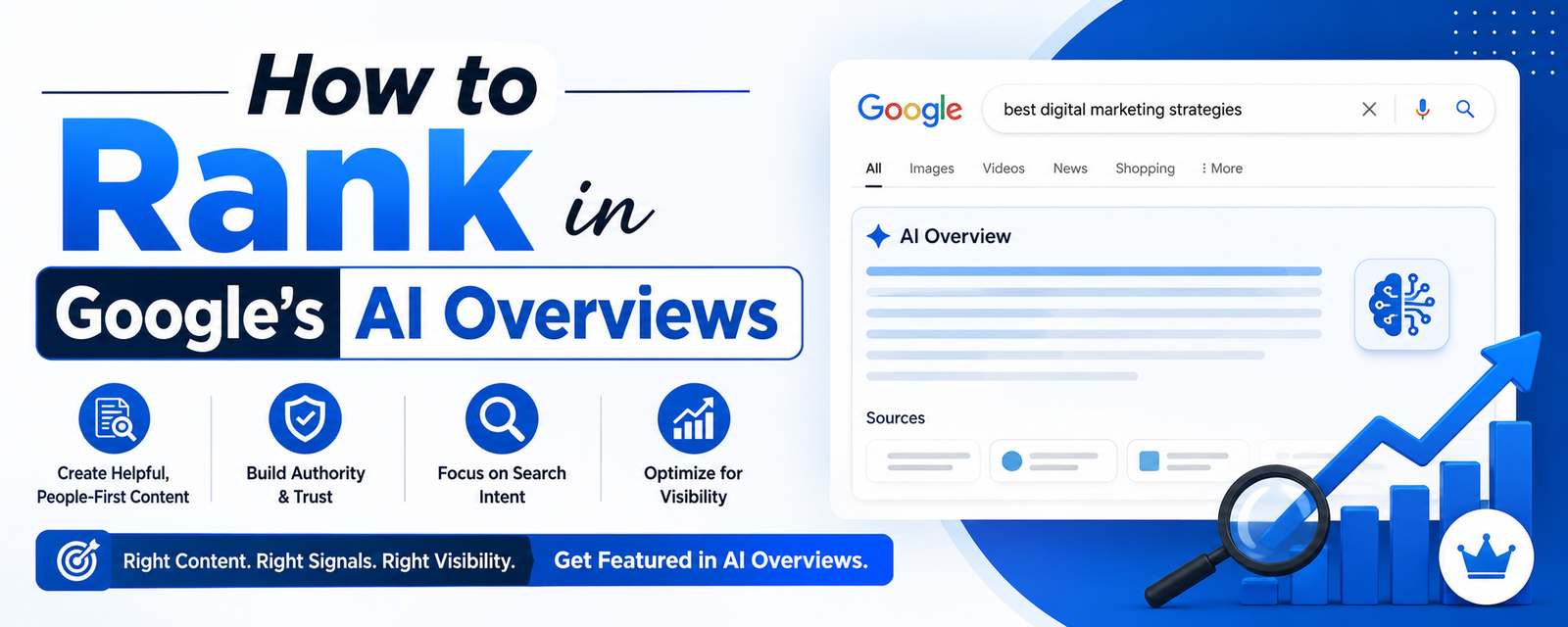
How to Rank in Google's AI Overviews
Google's AI Overviews are quietly changing how people search for information — and more importantly, how they consume it. The old playbook of traditional SEO is starting to lose its edge. Google's AI now pulls knowledge from multiple websites at once — Reddit, Instagram, Facebook, YouTube — and stitches it into a single, unified answer at the very top of the search page.
That means even if you're ranking on page one, you might not be getting the traffic you used to. But here's the silver lining: your content can appear inside the AI Overview itself — you just need to know how to position it.
This article walks you through exactly that.
What Are Google AI Overviews?
A Google AI Overview is an AI-generated summary that appears at the top of a search results page. Instead of sending you to a specific website, Google uses artificial intelligence to gather information from multiple sources and present you with a direct, consolidated answer.

Think of it like Google doing the reading for you and handing you the highlights.
For users, it's genuinely useful — faster answers, no need to jump between five different tabs. For website owners, it's a wake-up call. Users can now get the information they need without ever having to click through to your site.
That's why you need to start preparing your content for AI — not just for search engines.
Why Ranking in AI Overviews Matters
Since Google's May 2026 update rolled out, around 76% of businesses have already felt a measurable impact from AI Overviews. Here's why getting featured in them is such a big deal:
1. More Visibility
AI Overviews appear before anything else on the page — above traditional rankings, above ads, above everything. If Google's AI surfaces your content in that summary box, you're instantly more visible than whoever is sitting at position #1 organically. For example, if someone searches "best German classes in Jalandhar," and your content gets pulled into the AI Overview, you show up first — without having to fight for the top spot in conventional SEO.
2. Instant Authority and Credibility
When your content is cited by Google's AI, it carries a different kind of weight. Users tend to trust AI-generated answers, and by extension, the sources behind them. That builds brand authority fast — even for someone encountering your brand for the very first time.
3. First-Mover Advantage
Most businesses haven't optimized their content for AI yet. That's an opportunity. The earlier you adapt — by adding things like an LLMs.txt file, improving content structure, and expanding your platform presence — the harder it becomes for competitors to catch up.
Read the Rated Article AI SEO Trends in 2026
8 Proven Tips to Rank in Google's AI Overviews
1. Optimize Your Content With LLMs.txt
LLMs.txt is a proposed standard — a simple text file you place in the root directory of your website. It tells AI bots like Gemini, Anthropic, and OpenAI exactly what your site is about and how they should interpret your content. You can create this file using free online tools and have your developer add it to your site. It's a small step, but it directly signals to AI crawlers that your content is structured and ready to be used.
2. Target Long-Tail and Niche Keywords
The more specific a search query is, the better your chances of appearing in an AI Overview. When someone types "who provides the best German classes in Jalandhar," they're not just browsing — they want a specific answer. Google's AI loves precise, intent-driven queries like that, because it can give a clear, relevant response. Build your content around those kinds of questions.
3. Optimize for Generative Engine Optimization (GEO)
GEO — Generative Engine Optimization — is the new framework that matters. While traditional SEO focused heavily on backlinks and keyword density, GEO focuses on clarity, structure, and accuracy. These are the qualities AI cares about most when deciding what to pull into an Overview.
To optimize for GEO:
Write at a Grade 6–8 reading level (tools like Hemingway App can help you gauge this).
Avoid unnecessary jargon unless your audience genuinely expects it.
Use active voice and get to the point early.
Double-check your facts. AI models tend to skip over vague, outdated, or unverifiable information.
4. Use Structured Data (Schema Markup)
Schema markup is code you add to your website that helps Google's bots understand exactly what your page is about. It lets you communicate specific details — your business name, address, phone number, social media links, operating hours, and more — directly to search engines in a structured, machine-readable way. When Google understands your content more precisely, it becomes far easier for AI to include it in an Overview.
5. Keep Your Content Fresh and Updated
AI Overviews are designed to deliver current, accurate information. If your content is outdated, it's essentially invisible to the AI — no matter how well-written it is. Make it a habit to revisit and refresh your key articles regularly. Update statistics, replace old examples, and make sure the information still holds up. Fresh content doesn't just rank better — it gets trusted more.
6. Show Up on Multiple Platforms

Google's AI doesn't only pull from websites. It gathers information from YouTube, Instagram, Reddit, Quora, Facebook, and other platforms too. The more places you're visible with quality content, the higher your chances of being referenced in an AI Overview. Answer questions on Reddit and Quora. Post helpful videos on YouTube. Be present where conversations in your niche are already happening.
7. Write in a Natural, Conversational Tone
AI is built to have conversations. When your content sounds robotic, stiff, or overly technical, AI has a harder time pulling clean answers from it — and users have a harder time reading it. Write like you're explaining something to a friend who's smart but not an expert in your field.
Here's why this matters beyond just rankings:
AI mirrors human conversation. Content that matches that tone is easier for AI to summarize and cite in Overviews.
It keeps users engaged. Approachable writing builds trust and encourages people to stay longer on your page.
It widens your reach. When non-experts can understand your content, more people benefit from it — and share it.
8. Build Your E-E-A-T Signals
Experience, Expertise, Authoritativeness, and Trustworthiness (E-E-A-T) are not just traditional SEO signals — they're what AI models use to evaluate whether a source deserves to be cited. Add author bios with real credentials, cite reputable sources, link to original research, and keep your "About" page up to date. AI tends to favor content that looks like it was written by someone who actually knows what they're talking about.
Final Thoughts
Ranking in Google's AI Overviews isn't as complicated as it might seem at first. It's less about gaming algorithms and more about doing the fundamentals well — writing clearly, staying current, being consistent across platforms, and making sure your website speaks a language that both humans and AI can understand.
The businesses that move on this early will have a real edge. The ones who wait will find it a lot harder to catch up.
FAQ
Q: Can AI-generated content rank in AI Overviews?
Ans: Yes, it can — but only if it passes a quality bar. AI content needs to be fact-checked, follow E-E-A-T guidelines, and ideally have some level of human review. Google's systems are getting better at detecting low-effort AI content, so quality still matters.
Q: How do I optimize my website for AI Overviews?
Ans: Start with these four steps:
Follow E-E-A-T principles — make sure your content is well-researched and authored by someone credible.
Focus on clear, structured, direct answers to specific questions.
Build your presence across multiple platforms with quality content.
Participate in Q&A platforms like Reddit and Quora in your area of expertise.
Q: Who are the big four in AI?
Ans: Google, Microsoft, Amazon, and IBM are widely considered the four dominant players in the AI industry right now.
Q: How long does it take to rank in AI Overviews?
Ans: If your content follows E-E-A-T guidelines and is well-researched, most websites start seeing results within 2 to 3 months. That said, other factors play a role too — your niche authority, content format, and how frequently Google updates its AI models.