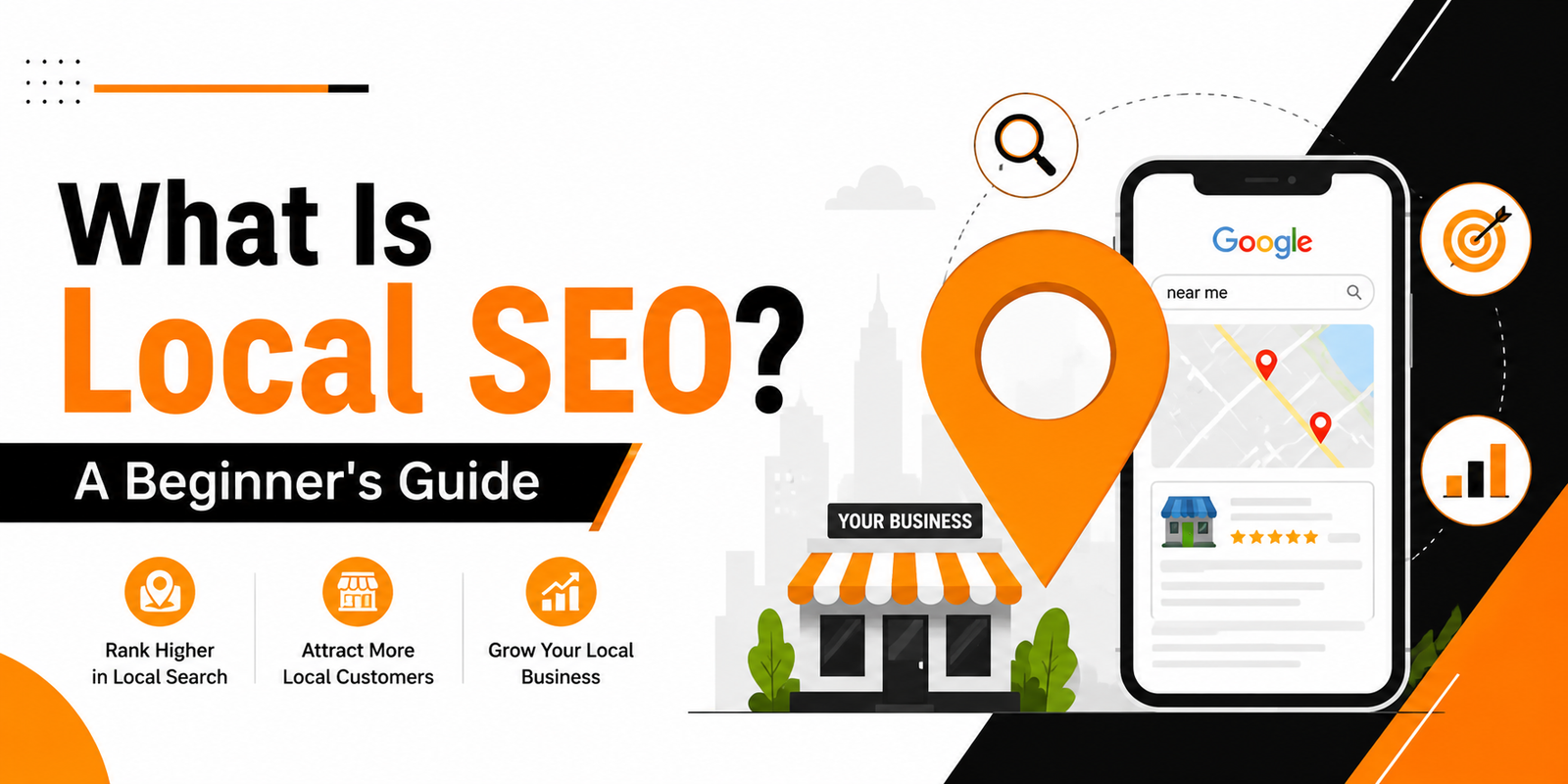
What Is Local SEO? A Beginner's Guide for Business Owners.
If you've ever typed something like 'dentist near me' or 'best chai near Connaught Place' into Google, you've already experienced local SEO — you just didn't know that's what it was called.
Local SEO is the process of making sure your business shows up when people nearby are searching for what you offer. It's not about reaching the whole country or the whole internet. It's about being visible to the right people, in the right place, at the right moment — when they're ready to visit, call, or buy.
For a lot of small and medium businesses in India, local SEO is genuinely the highest-return digital marketing activity available. And yet most business owners either don't know what it is or assume it's too technical for them to get involved with.
This guide is written for business owners, not SEO professionals. No jargon, no assumed knowledge. Just a clear explanation of what local SEO is, why it matters, how it works, and what you can start doing about it.
What Is Local SEO, Exactly?
SEO stands for Search Engine Optimisation. It's the practice of improving how your website and online presence appear in search results — specifically Google, which handles the overwhelming majority of searches in India.
Local SEO is a specific branch of SEO focused on location-based searches. The goal is simple: when someone in your area searches for the type of product or service you offer, your business should appear.
That might mean appearing in:
The Google Map Pack — the three business listings that appear at the top of local search results, with a map
Google Maps itself, when someone searches directly in the app
The regular search results below the map, where your website appears as a link
Google's Knowledge Panel — the information box that appears on the right side of the screen when someone searches for your business by name
Local SEO vs Regular SEO — What's the Difference?
People often ask whether local SEO and regular SEO are the same thing. They overlap, but they're not identical.
Regular SEO is about ranking in search results broadly — for example, a food blog in Mumbai trying to rank for 'best recipes for monsoon season' doesn't need to target a specific location. They're writing for anyone, anywhere, who might search that phrase.
Local SEO is specifically about connecting businesses to nearby customers. Location is everything. A bakery in Lajpat Nagar doesn't need to rank nationally for 'bakery' — they need to rank in South Delhi for 'bakery near me' or 'best bakery in Lajpat Nagar'.
For most local businesses — restaurants, clinics, shops, salons, local service providers — local SEO should come before any other form of digital marketing. It's where the immediate, high-intent customers are.
Why Does Local SEO Matter So Much Right Now?
Three things have happened over the past decade that make local SEO more valuable than it's ever been.
Mobile search changed everything
Most searches in India now happen on mobile phones. When someone is out, wants something nearby, and searches for it — Google uses their location to show them relevant local businesses. If your business isn't optimised for local search, you simply don't exist for those searches. The person finds a competitor, calls them, and you never even knew the opportunity was there.
People search before they visit
Even when someone already knows a business exists, they often Google it before visiting — to check opening hours, find the address, see photos, or read reviews. If your Google Business Profile is incomplete, outdated, or missing, that pre-visit check creates doubt instead of confidence.
'Near me' searches have exploded
Searches including 'near me' have grown dramatically. People don't just search for 'plumber' anymore — they search 'plumber near me', 'emergency plumber open now', 'best plumber in Dwarka'. These searches have extremely high commercial intent. The person isn't browsing — they need someone now. Being present for these searches means capturing customers who are ready to spend money.
How Does Google Decide Which Local Businesses to Show?
Google uses three main factors to rank local business results. Understanding these is the foundation of understanding local SEO.
1. Relevance
Does your business match what the person searched for? Google compares the search query against your business category, your profile description, the services you list, and the content on your website. The more closely your online presence reflects what you actually do, the more likely Google is to show you for relevant searches.
2. Distance
How far is your business from the person who searched? Google factors in the searcher's location and shows businesses that are physically nearby. This is why a restaurant in Karol Bagh doesn't appear when someone in Vasant Kunj searches 'restaurant near me' — unless they specifically search for Karol Bagh.
You can't change your physical location, but you can make sure your address and service area are accurately set up in your Google Business Profile, so Google knows exactly where you operate.
3. Prominence
How well-known and trusted is your business online? Prominence is built from several signals — the number and quality of your Google reviews, how often your business name appears across other websites and directories, how active your Google Business Profile is, and how authoritative your website appears.
This is the factor you have the most ability to influence over time. A newer business can build prominence faster than it can change its location or change what it does.
The Building Blocks of Local SEO
Local SEO isn't one single thing — it's a combination of several activities working together. Here are the key ones every local business needs to understand.
Google Business Profile
If local SEO had a single most important element, this would be it. Your Google Business Profile (previously called Google My Business) is the listing that appears on Google Maps and in the Map Pack. It shows your business name, address, phone number, opening hours, photos, reviews, and more.
An incomplete or unoptimised profile is one of the most common reasons local businesses don't appear in relevant searches. At minimum, your profile needs to be:
Fully verified by Google
Assigned the correct primary business category
Complete with accurate name, address, and phone number
Stocked with genuine photos of your business, team, and products or services
Regularly updated with posts, offers, and current opening hours
NAP Consistency
NAP stands for Name, Address, and Phone number. Google cross-references your business information across the internet — your website, your Google profile, local directories, social media pages — to verify that you are who you say you are. If your name is listed slightly differently in different places, or your phone number on your website doesn't match your Google listing, these inconsistencies weaken Google's confidence in your listing and can suppress your rankings.
The fix is straightforward: make sure your business name, address, and phone number are identical everywhere they appear online. Include the same format — if your website shows your number as 011-XXXXXXXX, your Google profile should show the same format.
Local Keywords
Keywords are the phrases people type into Google. For local SEO, your target keywords need to include location. 'Hair salon' is a broad keyword. 'Hair salon in Rajouri Garden' is a local keyword. 'Best hair salon near Rajouri Garden metro' is an even more specific local keyword.
Your website pages — particularly your homepage and your service pages — should naturally include location-relevant keywords. Not crammed in unnaturally, but worked into descriptions of your services, your team, and the areas you serve.
Online Reviews
Reviews are one of the strongest local ranking signals Google has. Businesses with more genuine, positive reviews consistently outperform those with few or no reviews — even when everything else is equal. Reviews also directly influence whether a potential customer chooses your business or moves on to a competitor.
The key word is genuine. Google is sophisticated at detecting fake or incentivised reviews, and getting caught doing it can result in review removal or worse, a suspended listing. The right approach is to make it easy for genuinely happy customers to leave reviews — through a direct link, a WhatsApp follow-up, or a simple in-person request.
Local Citations
A citation is any mention of your business name, address, and phone number on another website — even if it doesn't include a link back to your site. Being listed consistently on trusted Indian directories like JustDial, IndiaMART, Sulekha, and IndiaBizList, as well as global ones like Bing Places and Apple Maps, signals to Google that your business is legitimate and well-established.
On-Page Optimisation
Your website needs to signal its local relevance to Google. This means including your city and area in page titles, headings, and body content where it fits naturally. It means having a dedicated contact page with your full address and an embedded Google Map. It also means adding LocalBusiness schema markup — a piece of code that tells Google exactly what type of business you are, where you're located, and when you're open.
Website Speed and Mobile-Friendliness
Google ranks fast, mobile-friendly websites higher — in both local and regular search. Most local searches happen on mobile, so a website that loads slowly or is hard to use on a phone is actively costing you rankings. This is a technical area that typically requires a developer to address, but it's worth being aware of as a factor.
Local SEO for Different Types of Businesses
Local SEO looks slightly different depending on what type of business you run.
Businesses with a physical location
Shops, restaurants, clinics, salons, showrooms — any business where customers come to you. For these businesses, the priority is appearing in local searches and on Google Maps for people in the surrounding area. Your Google Business Profile address should be your actual business address, and your profile should have photos of the exterior so customers can recognise it when they arrive.
Service-area businesses
Plumbers, electricians, caterers, cleaners, tutors, and anyone else who goes to the customer rather than having customers come to them. These businesses set up their Google Business Profile as a service-area business — hiding their home address but listing the areas they serve. Local SEO for service-area businesses focuses heavily on the areas you list and the keywords associated with what you do.
Businesses with multiple locations
If you have more than one branch, each location needs its own Google Business Profile, its own location page on your website, and its own local SEO effort. You can't manage all your locations through a single profile — each one needs to be individually optimised.
If you want to go deeper on what a properly managed local SEO campaign looks like in practice — the activities, the timeline, and the specific outcomes you can expect — our local SEO services page walks through exactly how we approach it for businesses in Delhi and across India.
How Long Does Local SEO Take to Work?
This is the question every business owner asks, and the honest answer is: it depends — but it's generally faster than people expect for local results, and slower than people hope for competitive terms.
For completely new businesses or unclaimed profiles, just setting up and verifying a Google Business Profile correctly can produce visible results within a few weeks. You'll start appearing in searches you weren't showing up for at all before.
For more competitive local markets — or for businesses competing for high-value search terms in busy areas — meaningful ranking improvements typically take three to six months of consistent effort. That means consistently managing reviews, keeping the profile updated, publishing relevant content, and building citations over time.
The important thing to understand is that local SEO is cumulative. Each improvement builds on the last. A business that starts properly in January will be significantly stronger by June, and even stronger by December. Businesses that try it for a month, see limited results, and stop miss out on the compounding effect.
Common Local SEO Mistakes to Avoid
These are the ones we see most often when a business comes to us saying their local SEO isn't working.
Leaving your Google Business Profile unclaimed or incomplete
An unclaimed profile is one that exists in Google's database — often because Google has created a basic listing automatically — but hasn't been verified by the business owner. Unclaimed profiles can have wrong information and can't be managed or optimised. If you haven't claimed yours, that's the first thing to do.
Stuffing keywords into your business name
Adding extra keywords to your business name field — beyond your actual trading name — violates Google's guidelines and can get your profile suspended. Your business name on Google should match the name on your signage and registration. Nothing more.
Ignoring negative reviews
Not responding to reviews — particularly negative ones — sends a signal to potential customers that you don't care. Responding professionally to a negative review can actually build more trust than a perfect five-star rating, because it shows you're attentive and take customer feedback seriously.
Inconsistent NAP across the web
Even minor variations — 'St.' vs 'Street', '011' vs not including the area code — create inconsistencies that weaken your local signals. Audit your listings across directories periodically and make sure everything matches.
No photos, or only stock photos
Google Business Profiles with genuine photos of the actual business get significantly more engagement than those without. Stock images or generic graphics don't build trust — real photos of your premises, your team, your products, or your work do.
Treating local SEO as a one-time task
Local SEO is not something you set up once and forget. Google's local algorithms change, competitors invest in their profiles, new reviews come in, and your business details can change. It requires regular attention — not daily, but consistent monthly upkeep at minimum.
Where to Start If You're a Complete Beginner
If this is all new to you, here's a simple starting sequence. Don't try to do everything at once — work through these in order.
Claim and verify your Google Business Profile at business.google.com. If a profile already exists for your business, claim it. If not, create one from scratch.
Complete every section of your profile — business name (as it appears on your signage), address or service area, phone number, website, category, description, and opening hours. Don't skip fields.
Add real photos. At minimum: your exterior, your interior, and at least one photo of your team or products. Ten or more photos is better.
Make sure your website contact page has your exact business name, address, and phone number — matching your Google profile exactly.
Ask your five most recent happy customers for a Google review. Not with an incentive — just a genuine ask. A short personal message explaining how much reviews help small businesses usually works well.
List your business on JustDial, IndiaMart, Sulekha, and Bing Places. Use the same business name, address, and phone number you have on Google.
Keep going. Update your profile regularly. Respond to every review. Keep asking customers for reviews. The businesses that rank well locally are usually not doing anything sophisticated — they're just doing the basics consistently.
Frequently Asked Questions
Do I need a website for local SEO?
Not to get started, a Google Business Profile alone can help you rank in Maps without a website. But a website significantly improves your local SEO over time, particularly for appearing in the regular search results below the Map Pack. If you don't have one yet, it's worth investing in.
Is local SEO free?
The core elements — setting up and managing a Google Business Profile, building citations on free directories, asking customers for reviews — cost nothing except your time. Professional local SEO services come at a cost, but for many local businesses, the basics done well by the owner themselves can produce meaningful results before any professional help is needed.
What is the Google Map Pack?
The Map Pack is the section that appears near the top of Google search results for local queries — usually three business listings displayed with a map. It's the most visible position in local search and generates the highest number of clicks for most local searches. Getting into the Map Pack for your key search terms is the primary goal of local SEO.
Does local SEO work for service-area businesses?
Yes, absolutely. Plumbers, electricians, cleaners, tutors, and delivery services — any business that serves customers at their location rather than at a fixed premises — can benefit from local SEO. The setup is slightly different (you hide your address and list a service area instead), but the principles are the same.
How important are Google reviews for local SEO?
Very important. Reviews are one of the top signals Google uses to rank local businesses. Businesses with more genuine, high-quality reviews consistently outperform those with few reviews — even when other factors are similar. Beyond rankings, reviews also directly influence whether potential customers choose your business or a competitor.
Can I do local SEO myself, or do I need an agency?
You can handle the basics yourself — and for many smaller businesses, doing so is perfectly sufficient. Claiming your profile, completing it fully, managing reviews, and keeping information updated are all things an engaged business owner can do. Where an agency adds value is in the more technical aspects: citation audits, on-page optimisation, schema markup, content strategy, and competitive analysis for more contested local markets.
How is local SEO different from Google Ads?
Google Ads places your business at the top of search results in exchange for payment — you pay per click, and you only appear while your budget is running. Local SEO earns you organic visibility that doesn't disappear the moment you stop paying. The two work well together, but local SEO builds something permanent where ads build something temporary.
My competitor always appears above me — why?
Most commonly, it comes down to one or more of three things: their Google Business Profile is more complete and active than yours, they have more genuine reviews, or their website has stronger local signals. Go through their profile and compare it to yours — look at the number of photos, the number of reviews, how recently they posted an update, and what their business description says. That comparison usually makes the gap pretty clear.
More From the Code Web Creation Blog
Local SEO Services in Delhi — How We Do It — codewebcreation.com/local-seo
Why Your Google Business Profile Is Not Ranking
How to Recover a Suspended Google Business Profile
How to Get More Reviews on Google Business Profile (The Right Way)
GMB Phone Number Verification: How to Add and Verify Your Number
Want Help with Your Local SEO?
Getting your Google Business Profile set up properly and consistently managed is one thing. Competing in a busy local market — ranking above established businesses for high-intent local searches — takes a more structured, ongoing effort.
At Code Web Creation, local SEO is one of the core services we deliver for businesses in Delhi and across India. We've helped businesses go from invisible to consistently appearing in the Map Pack for their most valuable search terms. If you want to understand what that would look like for your specific business, get in touch — we're happy to take a look at where you stand and what it would take to improve.
Talk to Code Web Creation about local SEO for your business.