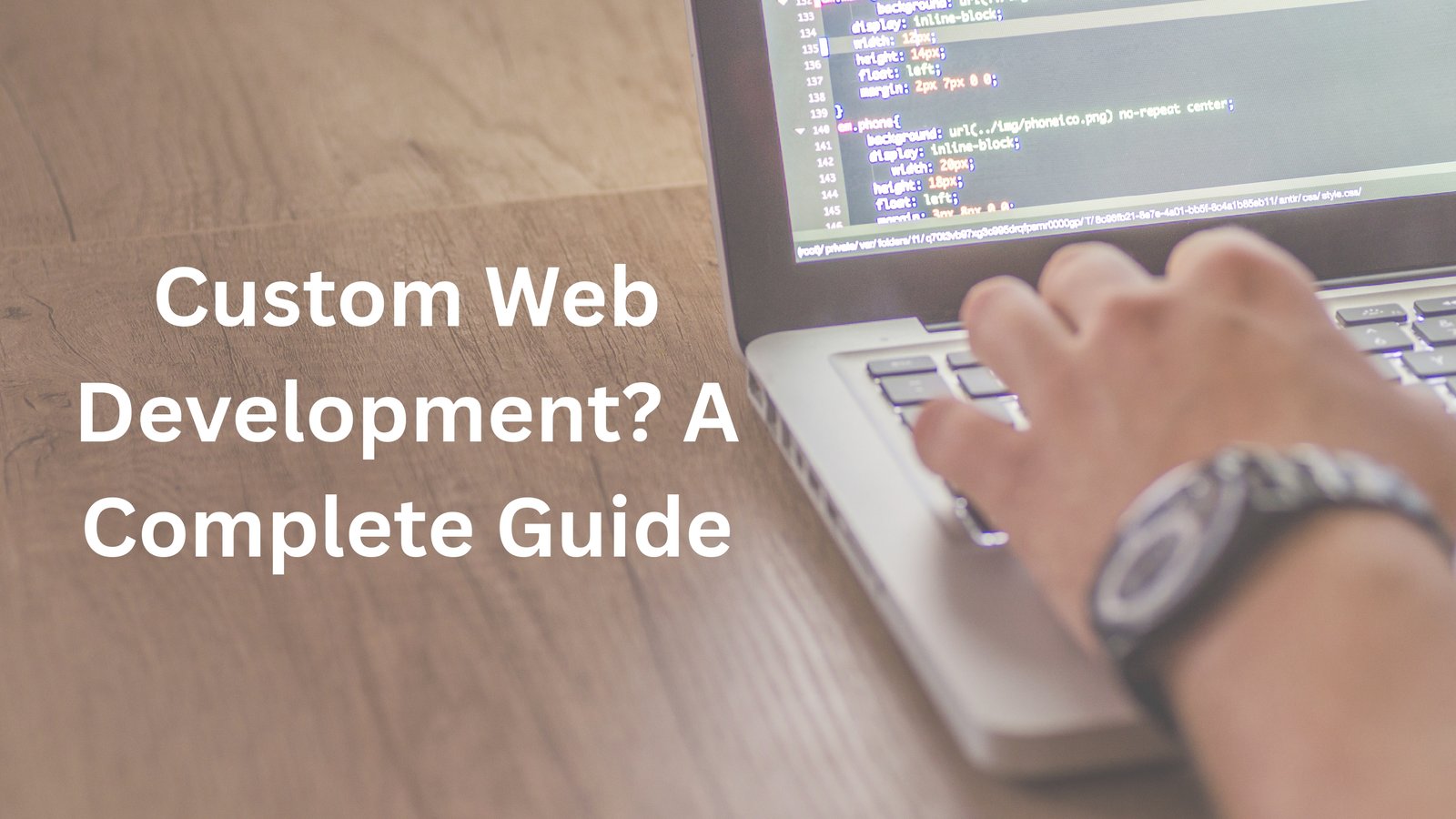
What Is Custom Web Development? A Complete Guide for Modern Businesses
If you have ever looked at your website and thought, “This doesn’t really fit my business anymore,” you are already asking the right question.
Many businesses start with a website template, a page builder, or a basic CMS setup. That can work in the beginning. But as your business grows, your website often needs to do more than just “look good.” It needs to generate leads, support marketing, integrate with tools, handle custom workflows, and create a smoother experience for users.
That is where custom web development comes in.
In this guide, you will learn what custom web development is, how it works, when it makes sense, what it costs, and whether it is the right choice for your business.
What Is Custom Web Development?
Custom web development is the process of building a website or web-based platform specifically for a business’s unique goals, users, branding, and functionality instead of relying entirely on pre-made templates or one-size-fits-all systems.
In simple terms, it means your website is designed and developed around what your business actually needs, rather than forcing your business to fit into the limits of a generic theme or builder.
Simple Definition
Custom web development means creating a website or web application from the ground up—or heavily tailoring it—to match a specific business need.
This could include:
a custom business website
a lead generation website
a booking platform
an ecommerce store
a learning portal
a membership website
a dashboard or admin panel
an internal business tool
So when people ask, “what is custom web development?”, the short answer is this:
It is a more flexible, strategic, and scalable way to build a website that is made for your business rather than borrowed from a template.
Why Custom Web Development Matters More Than Ever
A few years ago, many businesses could get by with a simple brochure-style website.
Today, that is often not enough.
Modern websites are expected to:
load fast
look professional on all devices
rank well on Google
collect leads efficiently
integrate with CRMs and marketing tools
support user journeys
help convert traffic into customers
That means a website is no longer just an online placeholder. It is often one of the most important business assets you have.
If your website needs to do more than display a few pages, custom website development becomes far more valuable.
Custom Web Development Meaning: What “Custom” Really Means
A lot of businesses hear the term custom web development and assume it only applies to large companies or expensive enterprise platforms.
That is not true.
“Custom” does not always mean overly complex. It simply means your website is built around your actual needs.
For example:
A coaching institute may need custom inquiry forms, course pages, WhatsApp integration, and city-based landing pages.
A law firm may need custom service pages, trust-building content layouts, and consultation booking forms.
An e-commerce brand may need custom checkout flows, product filtering, and integrations with inventory tools.
A startup may need user logins, dashboards, and account-based workflows.
A template might allow some of this. But in many cases, it becomes clunky, slow, or difficult to manage over time.
That is why businesses choose custom web solutions when they want more control and better long-term performance.
How Custom Web Development Works
To understand the real value of custom web development services, it helps to know how the process usually works.
A good custom website is not built by randomly coding pages. It is built through a structured process.
1) Discovery and Planning
This is where the business goals are understood first.
Before writing code, a developer or team should understand:
What does the business do?
Who are the target users?
What is the website supposed to achieve?
What actions should visitors take?
What features are needed now?
What features may be needed later?
This step is important because many websites fail not due to design, but due to poor planning.
A custom site should be built with business logic, not just visuals.
2) UI/UX Design
Once the goals are clear, the next step is designing how the website should look and function.
This includes:
wireframes
layout structure
navigation planning
mobile responsiveness
conversion-focused design
user journey mapping
This is where custom website development starts to feel different from a pre-made theme.
Instead of choosing from someone else’s layout, the site is designed around:
your audience
your offers
your brand
your goals
For example, a lead-generation business might need a homepage that pushes users toward booking a call, while an educational website may need a cleaner path toward course exploration and demo enrollment.
3) Frontend Development
Frontend development is the part users interact with directly.
It includes:
page layout
animations
buttons
forms
menus
mobile behavior
visual responsiveness
In a custom project, frontend development is often cleaner and more intentional than what happens with bloated themes or plugin-heavy builders.
This matters because performance, usability, and trust are all affected by how the frontend is built.
4) Backend Development
Backend development handles what happens behind the scenes.
This can include:
form handling
user logins
database connections
admin panels
booking logic
custom dashboards
CRM integrations
payment processing
automation workflows
If the frontend is what users see, the backend is what makes the website actually work.
This is especially important for custom web application development, where the site needs more than just static pages.
5) Testing and Launch
Before launch, a professional custom website should be tested for:
mobile responsiveness
browser compatibility
page speed
broken links
form functionality
SEO basics
security issues
layout bugs
A site that looks good but breaks on mobile or submits broken leads is not a successful site.
Testing is part of what makes custom web development for business more reliable when done properly.
6) Maintenance and Scaling
A website is not a one-time file you forget forever.
After launch, websites often need:
content updates
feature additions
technical fixes
speed improvements
plugin or dependency updates
security maintenance
SEO enhancements
One of the biggest advantages of custom website development is that it can evolve more cleanly over time—especially when it is built with scalability in mind.
What Is Included in Custom Web Development?
A custom website can include many different features depending on the business.
Here are some of the most common things included in custom web development services:
fully custom homepage and inner pages
custom contact and inquiry forms
custom service or product pages
landing pages for ads or SEO
CRM integration
WhatsApp click-to-chat setup
custom lead funnels
appointment or booking systems
payment gateway integration
e-commerce functionality
user login systems
dashboards and admin panels
learning management features
multilingual pages
analytics tracking
technical SEO structure
speed optimization
custom CMS or content editing setup
Not every business needs all of these.
That is actually the point.
A custom website is not about adding everything. It is about building what is relevant and useful for your specific business model.
Also Read Article: What Is Local SEO
Custom Web Development vs Template Website Development
This is one of the most important comparisons for businesses trying to decide what they need.
A lot of people searching for what custom website development is are really asking this:
“Do I actually need a custom website, or is a template enough?”
The honest answer is: it depends on your business goals.
Quick Comparison
When Templates Can Be Fine
A template website may be enough if:
you need a simple online presence
you have a very small budget
you only need a few pages
your business is still validating its offer
speed of launch matters more than flexibility
There is nothing wrong with starting there.
When Custom Is Better
Custom web development is usually a better choice if:
your website is central to lead generation or sales
you need custom functionality
you care about SEO and performance
your business has unique workflows
you want stronger branding
you need a website that can scale with growth
The problem with many template-based websites is not that they fail on day one. It is that they often become frustrating by month six or year two.
Benefits of Custom Web Development for Businesses
The biggest reason businesses choose custom web development for business is simple:
They want a website that works for their business, not against it.
Let’s look at the real benefits.
1) Built Around Your Business Goals
A custom website is designed to support what you actually want the website to do.
That may be:
getting more calls
generating more inquiries
improving conversion rates
helping users book appointments
selling products
collecting applications
improving user retention
Instead of trying to force these goals into a generic layout, the site is built around them from the beginning.
2) Better User Experience
Good websites do not just “look nice.” They guide users clearly.
Custom development allows you to create:
cleaner navigation
clearer page structure
better mobile usability
smarter calls to action
more intuitive user flows
That can directly affect bounce rate, lead quality, and conversions.
3) Stronger Branding
Templates often make websites look similar to dozens—or hundreds—of others.
With bespoke website development, you can create a stronger visual identity that actually reflects your business.
That includes:
layout style
typography
messaging structure
visual hierarchy
interaction design
trust-building presentation
This matters more than many businesses realize. A website often forms a first impression before a customer ever contacts you.
4) Better SEO Structure
A lot of people focus only on keywords when thinking about SEO.
But technical and structural SEO matter too.
A well-built custom site can support better:
clean URL structure
internal linking architecture
mobile performance
Core Web Vitals
page hierarchy
semantic HTML
schema implementation
crawl efficiency
In many cases, custom websites can rank better on Google not because they are “custom” by label, but because they are built more intentionally.
That said, custom development alone does not guarantee rankings. Content, search intent, topical authority, and link signals still matter.
But the right technical foundation helps.
5) Improved Performance and Speed
Many pre-made themes are loaded with features you never use.
That often leads to:
slow page speed
unnecessary scripts
bloated CSS/JS
plugin conflicts
A custom site can be built with only the code and features you actually need.
That often results in:
faster loading
cleaner performance
better mobile experience
stronger technical SEO foundation
And yes, speed affects both user experience and conversions.
6) Easier Integrations
Businesses often need their website to connect with other tools.
For example:
CRM systems
email marketing platforms
payment gateways
booking tools
analytics dashboards
WhatsApp
lead routing systems
internal databases
Custom web development gives you more flexibility to integrate these systems cleanly.
That can save time and reduce operational friction.
7) More Scalability
A good custom website should not just solve today’s needs. It should also make future improvements easier.
For example, you may start with:
service pages
lead forms
local landing pages
Later, you may want to add:
user accounts
course dashboards
payment features
multilingual content
automation systems
That is much easier when the site is built with long-term scalability in mind.
8) Better Security Control
No website is magically “safe,” but custom web development can offer better control over security practices when built correctly.
This includes:
controlled code structure
reduced plugin dependency
secure form handling
cleaner access management
more intentional backend setup
Security matters even more if your site handles:
customer data
payment information
logins
internal workflows
9) Higher Conversion Potential
At the end of the day, many business websites exist for one reason:
to produce results
A custom website can be optimized around conversion points like:
inquiries
calls
form submissions
bookings
sign-ups
purchases
That is why many businesses eventually move toward custom web solutions after realizing their basic website is not helping them grow.
Who Needs Custom Web Development?
Not every business needs it immediately—but many businesses benefit from it sooner than they expect.
Here are some of the businesses that often benefit most from custom website development.
Startups
Startups often need more than a basic marketing site.
They may need:
custom landing pages
investor-ready presentation websites
waitlists
user dashboards
MVP functionality
account systems
A custom site helps align the product and business model more effectively.
Service Businesses
Service businesses often need websites that do more than just list services.
For example, they may need:
city pages
service-specific lead funnels
quote request forms
WhatsApp integration
appointment booking
SEO landing pages
Examples include:
agencies
consultants
institutes
healthcare providers
legal firms
coaching businesses
Ecommerce Brands
Online stores often outgrow generic setups when they need:
advanced product filtering
custom product pages
subscriptions
bundles
custom checkout experiences
third-party integrations
That is where custom web application development and ecommerce customization become especially useful.
Educational Platforms
Educational businesses often need specialized features like:
course pages
student login areas
learning dashboards
application forms
demo booking
multilingual access
downloadable resources
A standard website builder can feel limiting very quickly in this space.
Enterprises
Larger organizations often need:
internal tools
secure portals
workflow automation
user role management
advanced reporting
custom data systems
These are classic use cases for custom web development services
Businesses Outgrowing DIY Platforms
This is one of the most common categories.
Many businesses start with:
WordPress themes
Wix
Squarespace
Shopify themes
drag-and-drop builders
Those tools are not “bad.”
But over time, businesses often run into issues like:
design limitations
plugin dependency
poor performance
SEO restrictions
technical messiness
limited flexibility
That is usually the point where custom development becomes worth considering.
When Is Custom Web Development Worth It?
This is probably the most important practical question in this entire guide.
Custom web development is worth it when:
your website is an important part of your business growth
you need custom features or workflows
your branding matters
you want stronger SEO performance
you need cleaner lead generation systems
you want long-term flexibility
you plan to scale
For many businesses, the question is not “Can I afford custom development?”
It is often:
“How much longer can I afford a website that is not doing enough?”
That said, custom development is not automatically the right answer for everyone.
When Custom Web Development May NOT Be Worth It
This is important for trust, and it is something many weak articles avoid saying.
You may not need custom web development yet if:
you only need a simple 3–5 page brochure site
your budget is very limited
you need something live immediately
your offer is still being tested
your website is not yet central to marketing or sales
your business needs are still extremely basic
In those cases, a simpler setup may be the smarter short-term choice.
That does not mean you should never go custom. It just means timing matters.
Common Examples of Custom Web Development
If the term still feels broad, these examples make it easier to understand.
Common examples include:
custom business websites
custom lead generation websites
local SEO landing page systems
ecommerce stores with custom checkout
student or learning portals
membership websites
appointment booking websites
real estate listing systems
SaaS dashboards
customer portals
internal admin systems
multi-location websites
custom quote calculators
multilingual websites
secure login-based platforms
A lot of businesses already need some form of custom web development—they just have not labeled it that way yet.
Technologies Used in Custom Web Development
This section helps explain the technical side without making it too heavy.
Different developers use different stacks depending on the project, but here are some common technologies used in custom website development.
Frontend Technologies
These shape what users see and interact with:
HTML
CSS
JavaScript
React
Next.js
Backend Technologies
These power the logic and data handling behind the scenes:
Node.js
PHP
Python
Laravel
Express
Databases
These store and manage data:
MySQL
PostgreSQL
MongoDB
CMS / Hybrid Setups
Some custom websites also use content systems:
WordPress (custom-built)
Headless CMS
Shopify custom frontend
Sanity / Strapi / Contentful setups
The best tech stack depends on the project.
A good development partner should choose tools based on business needs—not trends or hype.
How Much Does Custom Web Development Cost?
This is one of the most searched questions related to custom web development services.
The honest answer is:
It depends on scope.
But that should not be used as a lazy excuse. Businesses still need a practical idea of cost.
Typical Cost Ranges
1) Basic Custom Business Website
This may include:
custom design
homepage + key pages
lead forms
mobile responsiveness
basic SEO setup
Typical range: lower to moderate investment depending on market and provider
2) Mid-Level Custom Website or Business Platform
This may include:
advanced page structure
integrations
custom forms or workflows
lead systems
dashboard elements
custom admin controls
Typical range: moderate to high investment
3) Advanced Custom Web Application
This may include:
user accounts
dashboards
complex backend logic
database workflows
API integrations
custom portals or software-like functionality
Typical range: significantly higher depending on complexity
What Affects Cost?
The cost of custom website development usually depends on:
number of pages
design complexity
content requirements
custom features
integrations
backend logic
ecommerce needs
multilingual support
CMS requirements
SEO setup
testing and QA
maintenance expectations
A cheap custom project often becomes expensive later if it is built poorly.
That is why price should not be the only filter.
How Long Does Custom Web Development Take?
Timelines vary, but here is a realistic idea.
Common timelines:
Simple custom website: 2–6 weeks
Business website with strategy and features: 4–10 weeks
Advanced custom platform: 2–6 months or more
What affects the timeline?
project complexity
number of pages
revisions
content readiness
design approvals
feature development
integrations
testing requirements
One overlooked issue is this:
Sometimes the biggest delays are not coding delays—they are content and approval delays.
A good process matters just as much as technical skill.
Challenges of Custom Web Development
To make a smart decision, you should also understand the trade-offs.
Common challenges include:
higher upfront cost
longer development timeline
need for better planning
more involvement during the build
maintenance responsibility
dependence on the quality of your developer or agency
These are not reasons to avoid custom development.
They are simply planning factors.
If your website is important to your business, these trade-offs are often worth it—but only if the project is handled properly.
How to Choose the Right Custom Web Development Partner
A good custom website can become a growth asset.
A bad one can become a technical burden.
That is why choosing the right partner matters.
Here is what to look for:
1) Review Their Portfolio
Do not just ask, “Can you build websites?”
Ask:
Have you built websites for real businesses?
Do the sites look thoughtful or generic?
Do they show business understanding, not just visuals?
A portfolio should show problem-solving, not just screenshots.
2) Ask About Their Process
A serious custom development partner should have a clear process.
They should be able to explain:
discovery
planning
design
development
testing
launch
support
If the answer is basically “send content and we’ll make something,” that is not a strong sign.
3) Check Communication Quality
This is underrated.
Even a technically skilled developer can create a frustrating experience if communication is poor.
Pay attention to:
clarity
responsiveness
strategic thinking
ability to explain decisions
A good development partner should be able to speak both “business” and “technical.”
4) Ask About SEO and Performance
A website that looks nice but performs poorly is not enough.
Ask whether they consider:
mobile speed
technical SEO
page structure
Core Web Vitals
conversion flow
content flexibility
A good website should support visibility and growth, not just aesthetics.
5) Understand Ownership
Before starting, clarify:
Who owns the website?
Who owns the code?
Will you have admin access?
Will you be locked into a platform or provider?
This matters more than many businesses realize.
6) Ask About Support After Launch
Websites often need post-launch support.
Ask:
Do they offer maintenance?
Can they help with updates?
What happens if something breaks?
Can the site be expanded later?
A website should not become unusable the moment the project is finished.
Is Custom Web Development Good for SEO?
Yes—when done properly.
But let’s be precise.
Custom web development does not automatically make a website rank.
What it does is give you more control over the things that can support SEO, such as:
site speed
mobile performance
crawl structure
semantic code
internal linking architecture
schema setup
content flexibility
clean page hierarchy
If your website is central to content marketing or lead generation, that control can matter a lot.
That is one reason businesses investing in SEO often move toward custom web solutions rather than relying forever on rigid template setups.
FAQs About Custom Web Development
What is custom website development?
Custom website development is the process of building a website specifically for a business’s unique needs, branding, and functionality instead of relying only on pre-made templates.
Is custom web development expensive?
It usually costs more upfront than a template website, but it can provide better long-term value when your website plays an important role in growth, lead generation, SEO, or operations.
Is custom web development better than WordPress?
Not always. WordPress can be excellent when used properly. But businesses with more specific needs may benefit from a more tailored or custom-built setup depending on their goals.
Can custom websites rank better on Google?
They can, especially if they are built with strong technical SEO, speed, clean structure, and user experience in mind. But rankings still depend heavily on content quality, intent matching, and authority.
What is the difference between web design and web development?
Web design focuses on layout, visuals, and user experience.
Web development focuses on building the website’s actual functionality and technical structure.
In most custom projects, both are important.
Can small businesses benefit from custom web development?
Yes. Small businesses often benefit from custom development when they need stronger branding, better lead generation, local SEO landing pages, booking systems, or a website that supports growth more effectively.
What is the difference between a custom website and a web application?
A custom website is usually focused on content, branding, and user-facing pages.
A web application typically includes more advanced functionality like dashboards, logins, user accounts, workflows, and software-like behavior.
Final Thoughts: Is Custom Web Development Right for Your Business?
If your website only needs to exist, a basic setup may be enough.
But if your website needs to perform, convert, support growth, and adapt to your business, then custom web development becomes far more valuable.
The real strength of custom website development is not just that it looks unique.
It is that it gives your business more control over:
user experience
branding
SEO structure
lead generation
scalability
long-term flexibility